
Healthy Food Guide by KarbCoach
Great Value Oven Roasted Thin Sliced Turkey Breast: Longevity analysis
Quick answer
Occasional Choice
Great Value oven roasted thin sliced turkey breast received a Longevity Score of 74 out of 100 (occasional choice). Good protein, but processed with high sodium and additives. Strengths include good protein content and low saturated fat, while main considerations include high sodium content and processed with additives.
Longevity Score 74/100
What helped the score?
- Good protein content
- Low saturated fat
What held the score back?
- High sodium content
- Processed with additives
You are viewing the nutrition and longevity perspective. Switch to Food Integrity for ingredients and processing.
Source data, GTIN, and Healthy Food Guide analysis details
Product facts
- Product
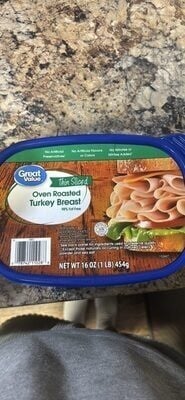
- Great Value Oven Roasted Thin Sliced Turkey Breast
- Brand
- Great Value
- Category
- Meat & Poultry (source: Pepperoni, Salami & Cold Cuts)
- GTIN / UPC
00078742110288- Serving size
- 51 g (4 slices, 16OZ. package)
- Source data — ingredients
- Ingredient list from product label data (see Sources)
- Healthy Food Guide analysis
- Independent Longevity and Food Integrity scorecards. See methodology under Sources.
- Data last verified
Great Value
Oven Roasted Thin Sliced Turkey Breast
KarbCoach Recommendation
Occasional Choice
Good protein, but processed with high sodium and additives.
What Stands Out
High Sodium
620mg sodium
27% DVLow Fiber
0g fiber
0% DVReal Turkey Breast
Primary protein source
Added Sweetener
Dextrose
Good Protein
9g protein
18% DVDV = Percent of Daily Value based on a 2,000 calorie diet
Key Positives
- Good protein content
- Low saturated fat
Key Concerns
- High sodium content
- Processed with additives
Ingredient Signals
Primary protein
Processing signals
Additives
Added sweeteners
Ingredients
Ingredient list
TURKEY BREAST, TURKEY BROTH, SALT, LESS THAN 2% OF: DEXTROSE, MODIFIED FOOD STARCH, POTASSIUM LACTATE, SODIUM PHOSPHATE, CARRAGEENAN, SODIUM DIACETATE, SODIUM ERYTHORBATE, NATURAL FLAVORING, HONEY, SODIUM NITRITE.
Formulations can vary — check the package label for the final word.
Macronutrients
Calories
50
3% DVTotal Carbs
2g
1% DVProtein
9g
18% DVSaturated Fat
0.5g
3% DVFiber
0g
0% DVNet Carbs
2g
1% DVSugar
1g
Added Sugar
1g
2% DVTotal Fat
1g
1% DVSodium
620mg
27% DVUnsaturated Fat
0.5g
DV = Percent of Daily Value based on a 2,000 calorie diet
Nutrition at a Glance
| Nutrient | Amount | % Daily Value |
|---|---|---|
| Calories | 50 | 3% DV |
| Total Carbs | 2g | 1% DV |
| Protein | 9g | 18% DV |
| Saturated Fat | 0.5g | 3% DV |
| Fiber | 0g | 0% DV |
| Net Carbs | 2g | 1% DV |
| Sugar | 1g | — |
| Added Sugar | 1g | 2% DV |
| Total Fat | 1g | 1% DV |
| Sodium | 620mg | 27% DV |
| Unsaturated Fat | 0.5g | — |
DV = Percent of Daily Value based on a 2,000 calorie diet
Amounts are per labeled serving from source data. Check the package for the final values.
Longevity scores estimate how this product’s nutrition and ingredient profile fit longer-term eating patterns. Formulations can vary — check the package label. Not medical advice. Some nutrient values may be estimated when the label is incomplete.
How this product may fit different goals
The same food can look different depending on what matters most to you. Here is a general preview of how this product may align with several common goals.
Low-Spike Stability
SupportiveMetabolic Health
For someone prioritizing Low-Spike Stability, the available data suggest this product may align in helpful ways.
A supportive signal: Lower net carbs (2g)
This product has 1 additional signal for this goal.
Heart-Healthy Eating
MixedMetabolic Health
For someone prioritizing Heart-Healthy Eating, the same nutrition and ingredient data show both supportive signals and tradeoffs.
A tradeoff: Higher sodium (620.2mg)
This product has 1 additional signal for this goal.
GLP-1 Eating Support
SupportiveMetabolic Health
For someone prioritizing GLP-1 Eating Support, the available data suggest this product may align in helpful ways.
A supportive signal: Moderate calories (50 kcal)
This product has 1 additional signal for this goal.
Low Sugar Lifestyle
MixedMetabolic Health
For someone prioritizing Low Sugar Lifestyle, the same nutrition and ingredient data show both supportive signals and tradeoffs.
A tradeoff: Sweetener signals (Dextrose)
This product has 1 additional signal for this goal.
Appetite & Portion Awareness
SupportiveMetabolic Health
For someone prioritizing Appetite & Portion Awareness, the available data suggest this product may align in helpful ways.
A supportive signal: Modest calories per serving (50 kcal)
This product has 1 additional signal for this goal.
Athletic Fueling
Watch-outsAthletic Performance
For someone prioritizing Athletic Fueling, the analysis identifies considerations that may matter more than the general product score alone.
A consideration: Lower carbs for fueling (2g)
Workout Recovery
SupportiveAthletic Performance
For someone prioritizing Workout Recovery, the available data suggest this product may align in helpful ways.
A supportive signal: Protein ingredients (Mentions "turkey". See ingredients for details.)
Strength & Protein Focus
SupportiveAthletic Performance
For someone prioritizing Strength & Protein Focus, the available data suggest this product may align in helpful ways.
A supportive signal: Protein ingredients (Mentions "turkey". See ingredients for details.)
Vegetarian
Watch-outsDietary Patterns
For someone prioritizing Vegetarian, the analysis identifies considerations that may matter more than the general product score alone.
A consideration: Meat/seafood ingredients (Mentions "turkey". See ingredients for details.)
Vegan
Watch-outsDietary Patterns
For someone prioritizing Vegan, the analysis identifies considerations that may matter more than the general product score alone.
A consideration: Animal-derived ingredients (Mentions "turkey", "honey". See ingredients for details.)
Plant-Based
Watch-outsDietary Patterns
For someone prioritizing Plant-Based, the analysis identifies considerations that may matter more than the general product score alone.
A consideration: Animal-derived ingredients (Mentions "turkey", "honey". See ingredients for details.)
Pescatarian
Watch-outsDietary Patterns
For someone prioritizing Pescatarian, the analysis identifies considerations that may matter more than the general product score alone.
A consideration: Land-meat ingredients (Mentions "turkey". See ingredients for details.)
Low-Carb Lifestyle
SupportiveDietary Patterns
For someone prioritizing Low-Carb Lifestyle, the available data suggest this product may align in helpful ways.
A supportive signal: Lower net carbs (2g)
This product has 1 additional signal for this goal.
Keto-Style Eating
SupportiveDietary Patterns
For someone prioritizing Keto-Style Eating, the available data suggest this product may align in helpful ways.
A supportive signal: Very low net carbs (2g)
This product has 1 additional signal for this goal.
Minimally Processed Eating
Watch-outsDietary Patterns
For someone prioritizing Minimally Processed Eating, the analysis identifies considerations that may matter more than the general product score alone.
A consideration: Sweetener signals (Dextrose)
This product has 1 additional signal for this goal.
Whole-Food Focused Eating
Watch-outsDietary Patterns
For someone prioritizing Whole-Food Focused Eating, the analysis identifies considerations that may matter more than the general product score alone.
A consideration: Sweetener signals (Dextrose)
This product has 1 additional signal for this goal.
Reduce Ultra-Processed Foods
Watch-outsDietary Patterns
For someone prioritizing Reduce Ultra-Processed Foods, the analysis identifies considerations that may matter more than the general product score alone.
A consideration: Sweetener signals (Dextrose)
This product has 1 additional signal for this goal.
Mediterranean-Style Eating
Watch-outsDietary Patterns
For someone prioritizing Mediterranean-Style Eating, the analysis identifies considerations that may matter more than the general product score alone.
A consideration: Higher sodium (620.2mg)
Paleo-Style Eating
Watch-outsDietary Patterns
For someone prioritizing Paleo-Style Eating, the analysis identifies considerations that may matter more than the general product score alone.
A consideration: Added-sugar cues (Mentions "dextrose", "honey". See ingredients for details.)
Low Gluten Eating
NeutralDietary Patterns
For someone prioritizing Low Gluten Eating, the Longevity data do not show a strong matching signal for this product.
Healthy Fat Focus
NeutralDietary Patterns
For someone prioritizing Healthy Fat Focus, the Longevity data do not show a strong matching signal for this product.
See how this product fits your goals
Choose what matters most to you and explore a more detailed interpretation of this product's nutrition, ingredients, and tradeoffs.
Understanding the Longevity analysis
What the Longevity analysis evaluates
The Longevity analysis looks at how a food fits broader dietary patterns over time. It combines nutritional composition with processing and ingredient-quality considerations, including ideas that originated in Meal Power Points and Food Integrity. The Longevity Score summarizes that wider picture on a 0–100 scale. It is educational context for packaged foods, not medical advice and not a guarantee of health outcomes.
Nutrients, balance, processing, and ingredients
Nutritional composition matters: protein, fiber, carbohydrates, glucose-related characteristics, fats, sodium, and micronutrients all influence how a food may support or challenge different dietary goals. Processing level and ingredient quality still count, because formulation can change the practical meaning of an otherwise tidy nutrient panel. Longevity treats those dimensions together rather than as a single nutrient number.
Who may prioritize Longevity
People following low-carbohydrate, keto-style, high-protein, glucose-conscious, or longevity-focused eating patterns often start with the Longevity analysis. It is also useful when you want one place that connects macros and micros with how processed the food is and how the ingredient list reads. The Longevity Score is designed for that broader comparison across products.
How Longevity differs from Food Integrity
Food Integrity is the focused analysis of processing, ingredients, additives, purity, and transparency. Longevity is the broader analysis of nutritional composition, metabolic and dietary characteristics, processing, and ingredient quality. A strong nutritional profile may still deserve closer Food Integrity review when additives, oils, sweeteners, or processing level raise questions the nutrient panel does not answer on its own.
Why the analyses overlap—and why to review both
The overlap is intentional. Food Integrity–related characteristics contribute to Longevity, while Food Integrity remains separately useful for deeper formulation detail. The two views are meant to complement each other, not cancel each other out. Some people reasonably prioritize one analysis based on their goals; reviewing both can reveal tradeoffs that one score alone may not show.
Common questions about this product
Is Great Value Oven Roasted Thin Sliced Turkey Breast highly processed?
Food Integrity lists processing level as Highly processed. That reflects formulation and processing signals from the ingredient analysis — not a medical or regulatory classification.
Why are the Longevity and Food Integrity scores different?
Longevity emphasizes nutrition per serving and longer-term dietary alignment. Food Integrity emphasizes ingredients, additives, processing, and label transparency. The same product can score differently on those lenses.
How much fiber is in one serving?
Great Value Oven Roasted Thin Sliced Turkey Breast shows about 0g of fiber per labeled serving in the Longevity nutrition facts.
Does it contain added sugar?
Great Value Oven Roasted Thin Sliced Turkey Breast: 1g added sugar per serving; sweetener signals include Dextrose. Confirm the current package Nutrition Facts and ingredient list.
What helped the Longevity Score?
Key positives called out in the analysis include: Good protein content; Low saturated fat.
What prevented a perfect Longevity Score?
Key concerns noted include: High sodium content; Processed with additives.
Who might evaluate this product differently?
People prioritizing different goals (for example lower carbs, higher protein, or minimally processed eating) may weigh the same meat & poultry differently. Use the goal preview on this page, then personalize in KarbCoach for your priorities.
Source data and Healthy Food Guide analysis
- Public label databases (including USDA FoodData Central and Open Food Facts) — Possible sources for package ingredients and nutrition.
- Healthy Food Guide analysis (Longevity and Food Integrity) — Independent Longevity and Food Integrity scorecards.
- How the Longevity Score is calculated
- How the Food Integrity Score is calculated
- Scoring models: KarbCoach Longevity and Food Integrity.
- Independent analysis. No manufacturer affiliation.
- Formulations can vary by region, size, and packaging. Check the package label for ingredients, allergens, and nutrition. Not medical advice — do not use this site or the KarbCoach mobile app for allergy or health decisions. Full sources and safety details.
Label accuracy and safety information
Formulations can vary by region, size, and packaging. Check the package label for ingredients, allergens, and nutrition. Not medical advice — do not use this site or the KarbCoach mobile app for allergy or health decisions.
See how this item lines up with your goals
Healthy Food Guide covers this product in detail. In KarbCoach, your goals shape what matters most for your meals.
Also available in the app